
Get Instant Quote
Pest controlHigh priority

Wasps & Bees

Vespula germanica, Polistes spp. & Apis mellifera

European wasp nests are destroyed at the source. Honey bee swarms are relocated by a beekeeper wherever it's possible — they aren't a pest.

When they're active: Colonies build from October, and European wasp nests reach their most aggressive size from February to April.
Get a quote Call 0433 452 155
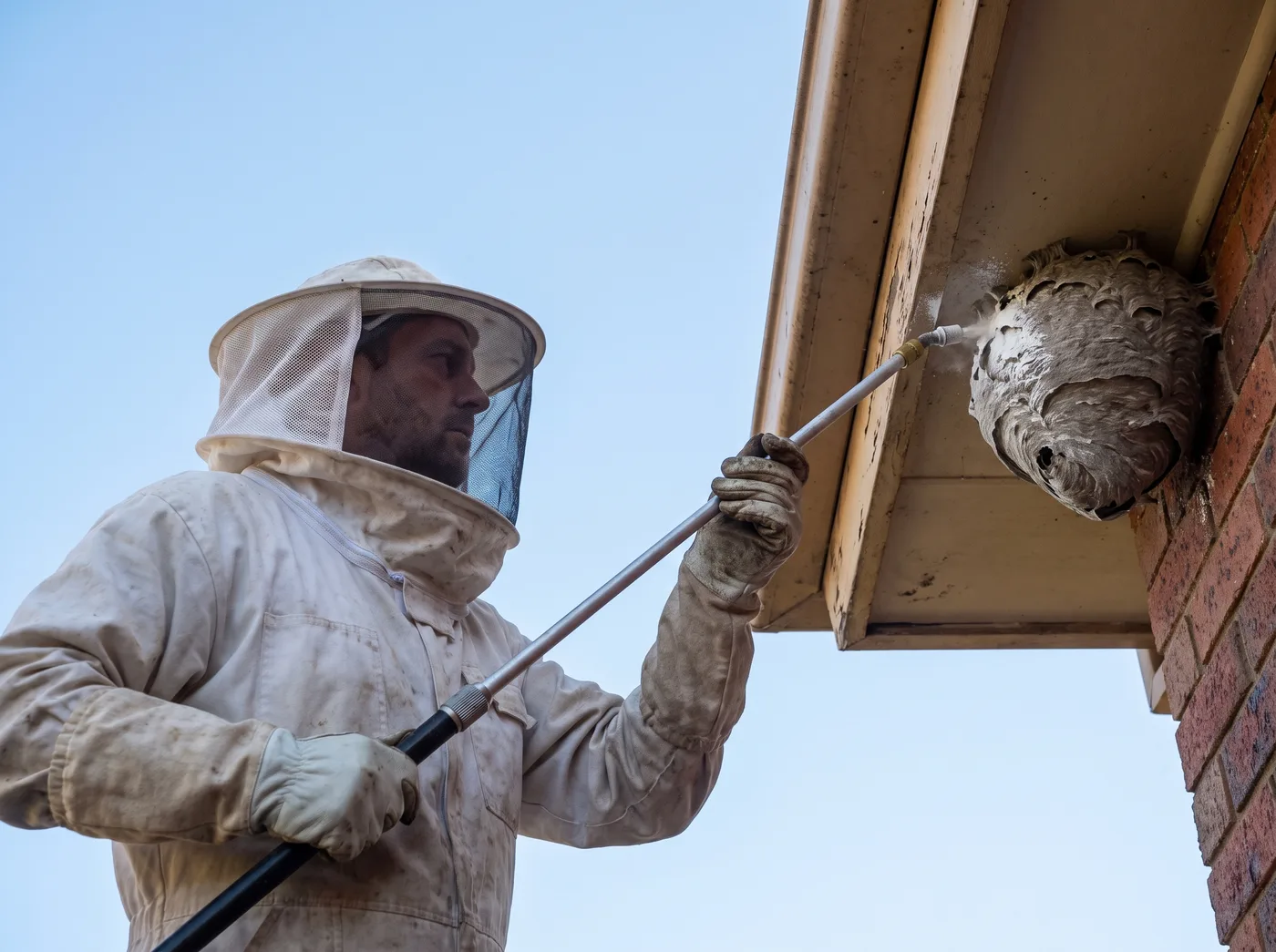
Protected technician treating a wasp nest beneath a roof eave
How to identify
European wasp
12–16mm, bright yellow and black with black antennae — nests in walls, roofs and the ground
Paper wasp
15–22mm, slimmer with dangling legs in flight — small open honeycomb nest under eaves and rails
Honey bee
12–15mm, golden brown and furry, carries pollen on its legs — a swarm hangs as a clustered ball
Where nests sit
Wall cavities, roof voids, retaining walls, compost, under eaves and pergolas, in ground holes
Overview

What you're actually dealing with.

There are two very different jobs on this page, and the difference matters.

European wasps are a serious problem in Melbourne. They sting repeatedly, defend the nest as a group, and build inside wall cavities, retaining walls, compost heaps and holes in the lawn where nobody sees them until the colony is large. By late summer a nest can hold thousands of workers. Mowing over a ground nest or hitting a cavity nest with a partial spray provokes exactly the response you’d expect. Nests are treated with dust at the entrance, usually at dusk, so returning foragers carry the active into the colony.

Honey bees are not a pest, and we won’t treat them like one. A swarm hanging on a branch or fence is a colony in transit, it is usually docile, and a beekeeper can generally collect and rehome it. That is our first recommendation every time. Only where an established colony sits inside a structure that cannot be opened, and where there is a real safety risk, does destruction come into it — and we will tell you which situation you’re in rather than defaulting to the chemical.

Paper wasps sit in between: small open nests under eaves and handrails, easily dealt with, worth removing before they’re above a doorway you use daily.

Signs of an infestation

A steady two-way stream of wasps into one point in a wall, eave or the ground
Wasps repeatedly landing on meat at a barbecue — European wasp behaviour, bees never do this
A small grey papery nest hanging under an eave, pergola beam or handrail
A hanging cluster of bees on a branch, fence or wall that appeared within a day
Buzzing or rustling audible through plasterboard or a ceiling
Problems caused

Why it's worth dealing with properly.

European wasps sting repeatedly and defend the nest en masse when disturbed
Anaphylaxis risk for sensitised people, and multiple stings are dangerous for anyone
Nests in wall cavities and roof voids can grow very large before anyone notices
Mowing over a ground nest triggers an immediate mass attack
Abandoned honeycomb left in a cavity melts, stains ceilings and draws ants and beetles
How we treat it

Our wasps & bees treatment.

01
Identify wasp or bee before anything else
This decides the entire job. European and paper wasps are destroyed at the nest. Honey bees are a different matter — we work to have swarms collected and relocated by a beekeeper wherever it can safely be done.
02
Locate the actual nest
The entry point is not always the nest. We watch the flight line and, for cavity nests, work out where the structure sits before opening anything up, so treatment lands on the colony rather than the doorway.
03
Treat the nest directly
An insecticidal dust is applied into the nest entrance in protective equipment, usually at dusk when the colony has returned. Returning foragers carry it inside, so the whole colony is reached rather than just the ones flying at the time.
04
Confirm the kill and remove where accessible
We return to verify there is no flight activity, then remove accessible nests. Nests deep in a cavity are left in place once dead — they are not reused, and cutting open a wall to retrieve one causes more damage than it prevents.
05
Proof the entry point
Once the nest is confirmed dead we seal the gap, weep hole, vent or roof junction that was used. Wasps repeatedly choose the same structural weak points in the same building.
Prevention

How to keep them out.

Worth doing whether or not you book us — most re-infestations trace back to one of these.

Keep bins sealed and rinse recycling — European wasps forage on sugar and protein waste
Cover food and drinks outdoors, and check cans before drinking from them
Never leave pet food or meat scraps outside over summer
Screen weep holes, vents, eave gaps and roof junctions before the spring build-up
Check eaves, pergolas and handrails monthly in spring, when nests are still golf-ball size
Walk the lawn before mowing and look for a stream of wasps entering a hole in the ground
Licensed & insured
Every treatment is carried out by a licensed technician under full public liability and WorkCover cover.
12-month warranty
Free re-treatment of the same pest at the same Melbourne address within 12 months of the covered work.
Reported & documented
A compliance-ready PDF listing products used, placements and technician licence details, emailed the same day.
FAQ

Wasps & Bees questions.

I have bees in my wall. Will you kill them?+
Not as a first option. Honey bees are under enough pressure already, and a swarm on a branch or fence is generally straightforward for a beekeeper to collect and rehome at no cost to you. We'll tell you honestly whether relocation is realistic in your situation, and help you find a collector.
When is destroying bees unavoidable?+
When an established colony is inside a wall or roof cavity, cannot be reached without structural demolition, and presents a genuine safety risk — someone in the house with an allergy, or a nest above a doorway used daily. We say so plainly rather than pretending there's no other option, and where a colony is destroyed the comb should be removed or it melts and stains ceilings.
How do I tell a European wasp from a bee?+
Colour and behaviour. European wasps are bright yellow and black, hairless and glossy, with black antennae. Bees are golden brown and furry. The quickest tell at a barbecue is the meat — European wasps land on it, honey bees never do.
Can I spray the nest myself?+
With a large European wasp nest, no. A partial hit provokes a mass defensive response from a colony that can sting repeatedly, and ground nests in particular are attacked in seconds. Small paper wasp nests are more manageable, but anything in a wall, roof or the ground should be left alone.
How quickly can you attend a wasp nest?+
Wasp nests are treated as priority work and we book same-week most weeks. In the meantime, keep everyone away from the flight path, close nearby windows, and don't mow or use power tools near a ground nest.
Will the nest come back next year?+
Not the same nest — wasp nests are abandoned at the end of the season and never reused. But the same wall gap, weep hole or roof junction attracts a new queen the following spring, which is why we seal the entry point rather than just treating and leaving.

Deal with wasps & bees properly.

Licensed technician, fixed pricing, 12-month warranty on covered work.

Get a quote Call 0433 452 155
Other pests we treat