
Get Instant Quote
Pest controlModerate priority

Spiders

Latrodectus hasselti, Lampona murina, Badumna insignis & Heteropoda spp.

Redbacks under the outdoor setting, black house spiders in the window frames — controlled by treating the harbourage and removing the food supply.

When they're active: Numbers build sharply from October and peak over the hot, dry stretch from December to March.
Get a quote Call 0433 452 155
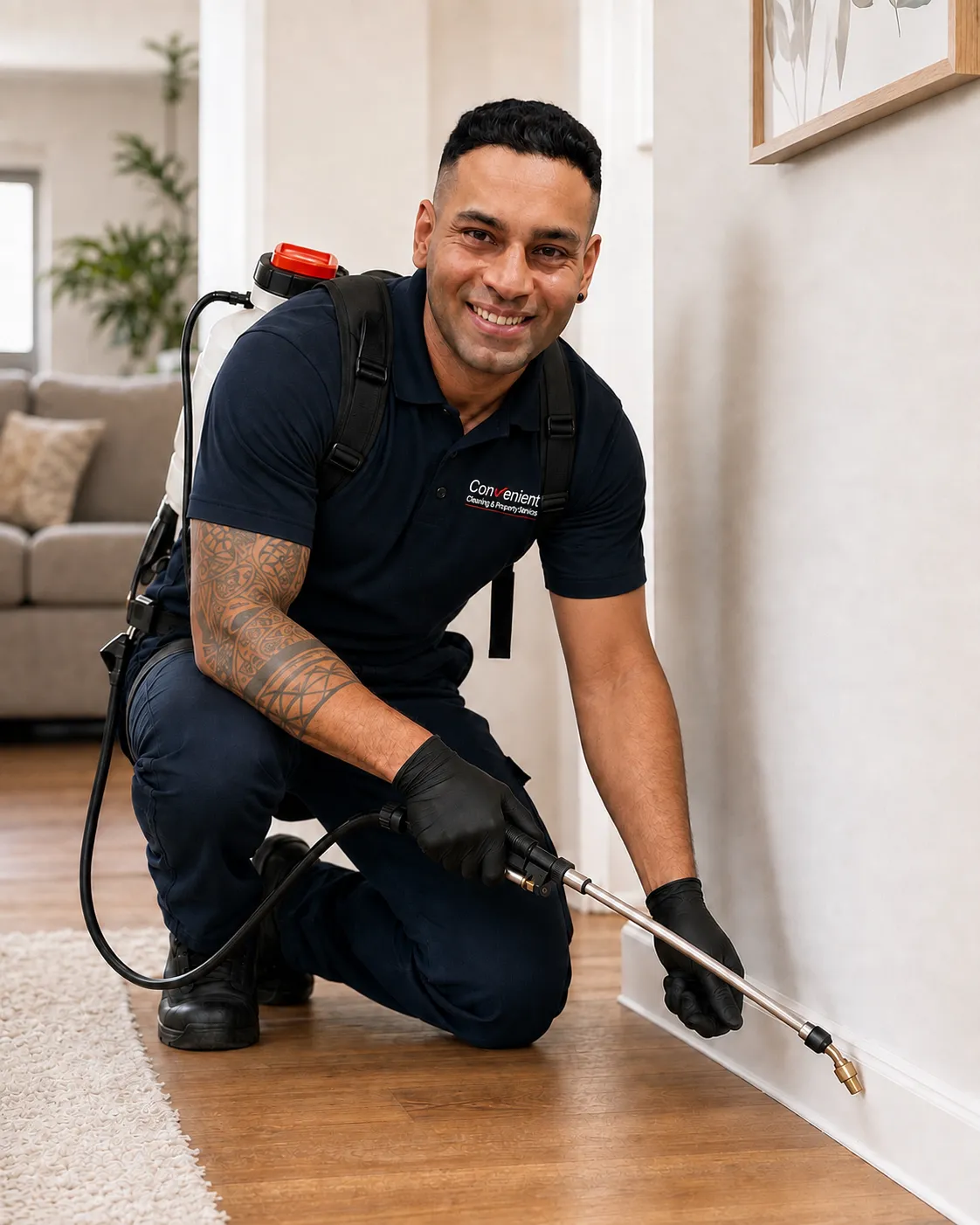
Pest technician applying a spider treatment along a skirting board inside a Melbourne home
How to identify
Redback
10mm female, glossy black with the red or orange dorsal stripe — tangled web low down in dry, sheltered spots
White-tail
12–18mm, dark grey cigar-shaped body with a pale tip — a roaming hunter, no web, comes indoors
Black house spider
10–18mm, dark and thickset, builds the messy funnel webs in window frames and eaves
Huntsman
Large, flat, fast, brown and hairy — harmless, lives under bark and behind wall cladding
Overview

What you're actually dealing with.

Most people call about spiders for one of two reasons: a redback found somewhere a child could reach, or webbing that reappears on the eaves within days of being brushed off. Both are solvable, and both need more than a can of surface spray aimed at a web.

Spiders are harder to treat than insects because they don’t groom or feed the way insects do, so bait is useless and much of a spray never reaches them. Webbing itself is a shield — spray over an intact web and the spider sits in the middle of it untouched. The work has to start with de-webbing, then a residual band across the surfaces they physically walk on.

Then there is the food supply. Spiders settle where insects gather, which in a Melbourne home means external lighting, weep holes, drains and garden beds. Treat the spiders and ignore the insects and the property is recolonised by the next generation within weeks. White-tails are the clearest example — they come inside hunting black house spiders, so clearing the window-frame webs removes the reason they enter at all.

We identify what you have, de-web the structure, treat harbourage and entry points, knock back the insect population feeding them, and walk you through the spots redbacks reliably choose.

Signs of an infestation

Funnel-shaped webs in window corners, eaves, weep holes and brickwork joints
Tangled, untidy webs under outdoor furniture, letterboxes, bike frames and pot rims
Small white or cream egg sacs suspended in webbing
Flat spiders appearing indoors at night, especially on ceilings and behind curtains
Webbing rebuilt within a day or two of being knocked down
Problems caused

Why it's worth dealing with properly.

Redback bites are medically significant and need urgent assessment, particularly in children
White-tail bites cause local pain, redness and swelling that can persist
Redbacks favour exactly the places people put their hands — under seats, in shoes, behind pot plants
Heavy webbing on eaves, render and window frames stains and looks neglected
Spider activity indoors usually signals another insect population feeding them
How we treat it

Our spiders treatment.

01
Inspect and identify what you actually have
Web-builders and ground hunters need different work. Redbacks and black house spiders are treated at the web and harbourage; white-tails and huntsmen are roamers and need a treated band they must cross to get inside.
02
Remove the webbing first
We de-web eaves, frames, weep holes and outdoor structures before anything is applied. Webbing shields the spider from contact with the treated surface, so spraying over an existing web achieves very little.
03
Apply a residual band to harbourage and entry
Eaves, window and door frames, weep holes, brickwork, fence lines, sheds and under decking are treated. Spiders pick the active up through their feet as they travel, which is how a contact treatment reaches a pest that doesn't groom or feed like an insect.
04
Reduce the food supply
Spiders stay where the insects are. We treat the flying and crawling insects around external lighting, drains and garden beds at the same time, because a property with nothing to eat holds far fewer spiders through summer.
05
Check high-risk spots and advise
We go through the places redbacks reliably choose — outdoor furniture undersides, meter boxes, letterbox voids, pot rims, kids' play equipment — and show you what to keep checking between treatments.
Prevention

How to keep them out.

Worth doing whether or not you book us — most re-infestations trace back to one of these.

Brush down webs from eaves, window frames and doorways every few weeks
Store shoes, gloves and garden tools inside sealed containers, not on the shed floor
Shake out outdoor cushions and check under table rims before use
Swap white external globes for warm or yellow lamps so fewer flying insects gather
Clear leaf litter, stacked timber, bricks and disused pots from against the walls
Seal gaps under external doors and around weep holes, vents and pipe entries
Licensed & insured
Every treatment is carried out by a licensed technician under full public liability and WorkCover cover.
12-month warranty
Free re-treatment of the same pest at the same Melbourne address within 12 months of the covered work.
Reported & documented
A compliance-ready PDF listing products used, placements and technician licence details, emailed the same day.
FAQ

Spiders questions.

Do I need to treat huntsman spiders?+
Not really, and we'll say so. Huntsmen are non-aggressive, eat cockroaches and other pests, and wander in rather than nest indoors. If they genuinely bother you we can treat the entry points and external cladding, but the honest answer is that they are one of the more useful things on your wall.
How dangerous is a redback bite?+
It is medically significant. Bites cause severe local pain that intensifies over the following hour, often with sweating and nausea, and antivenom exists. Seek medical attention immediately, especially for a child or an elderly person. This is the species we prioritise on every Melbourne inspection.
Why do spiders come back so quickly after I knock the webs down?+
Because knocking down webbing removes the structure, not the spider or the reason it chose that spot. If the eave is sheltered and the light above the door draws insects every night, the web is rebuilt within a day or two. Treatment plus insect control is what changes the outcome.
Are white-tails really attracted to houses?+
They come inside hunting other spiders, particularly black house spiders. That is the useful bit of information — reduce the web-building spiders around your windows and eaves and you remove the reason white-tails are entering in the first place.
Is the treatment safe for pets and vegetable gardens?+
Yes, with planning. We apply to structural surfaces and harbourage rather than open ground, keep clear of vegetable beds, fish ponds and beehives, and tell you the re-entry time before we start. Let us know where the animals are and we'll work around them.
How long does a spider treatment last?+
A well-applied external residual generally holds through a season, though heavy rain, direct sun on north-facing walls and pressure-washing shorten it. Most Melbourne homes do best with a treatment in early spring, before the summer build-up starts.

Deal with spiders properly.

Licensed technician, fixed pricing, 12-month warranty on covered work.

Get a quote Call 0433 452 155
Other pests we treat